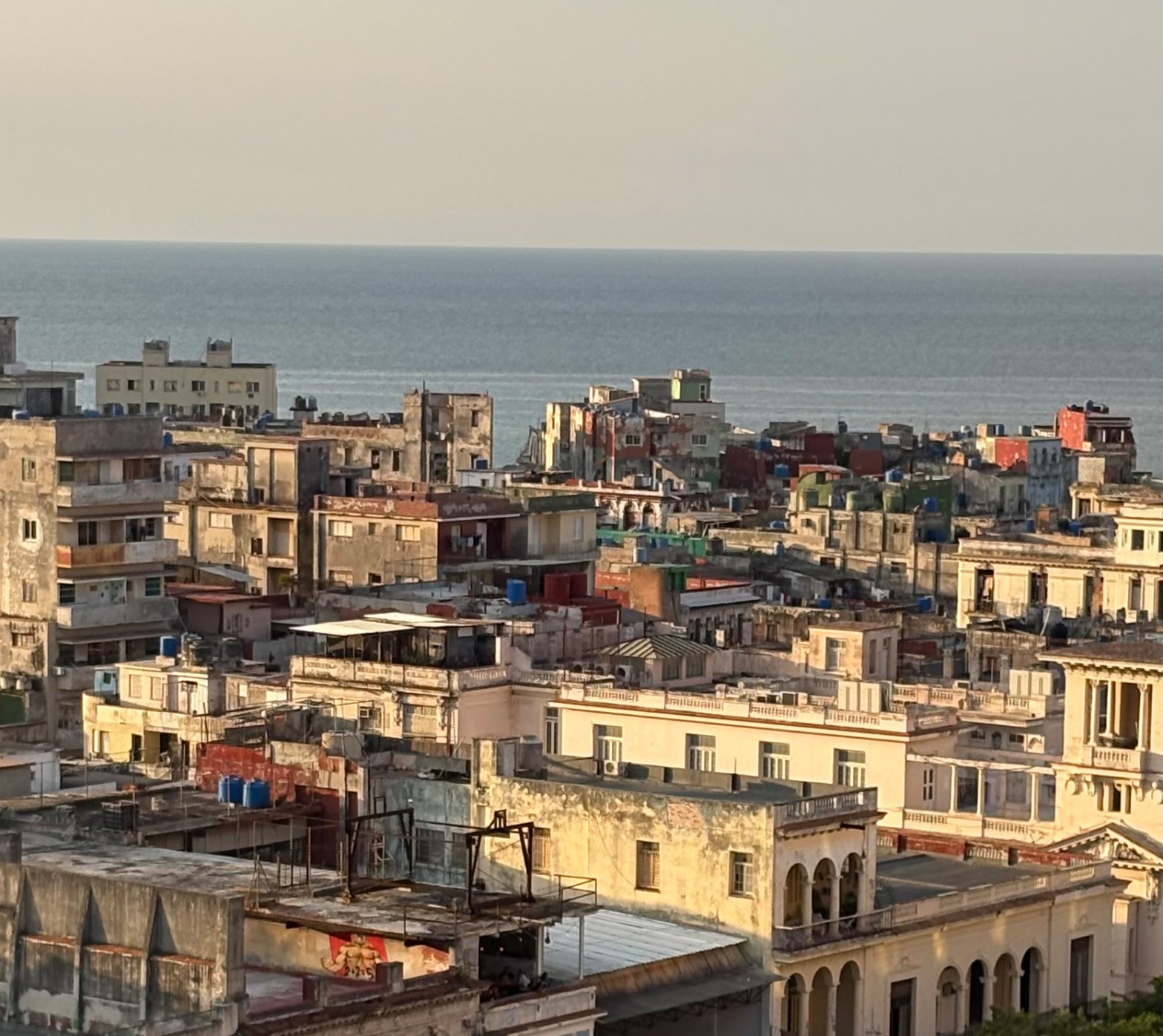
Even my daughter, a seasoned traveler who had been to Cuba on her own adventurous travels many years ago, was concerned about our planned Jewish Heritage tour to Havana. The news in the last weeks had been distressing with reports about severe food shortages and the dire conditions the Cubans had to deal with on a daily basis. A few days before we were supposed to leave, I called our tour director to check in with her on the latest developments and to hear from her if she thought it was safe and even sensible to travel to Cuba. Our tour leader, Miriam Levinson, has travelled to Cuba more than 200 times over the years. She assured me that her contacts told her our hotel was functioning and our tour bus had enough fuel, and we did not need to worry.
So, we decided to go forward with the attitude this trip would be a learning experience. We arrived in Miami for an overnight stay, gathering with our group of fifteen and having an orientation from our leader. The group was from all over the United States and it did not take two minutes for us to start playing “Jewish” geography. Everyone knew somebody, who knew somebody, etc., etc. We were a lively, friendly group ranging in age from early 60’s to a few over eighty. Two seniors were part of our group were not Jewish but they fit right in and seemed to enjoy everything. What is interesting about traveling with a Jewish group is sharing a baseline understanding about Jewish history, anti-Semitism, the Holocaust and having a common empathy about Israel especially since Oct. 7.
Miriam Levinson was born in Cuba, the daughter of Holocaust survivors. Her stories and anecdotes about growing up in Cuba in the Jewish community before fleeing in the 1950’s were the highlight of the trip for me. We learned about her grandparents, her sister, and Miriam’s childish pranks like falling into tar in her brand new party dress and her mother’s reaction. We loved visiting her childhood home which was narrow in a railroad style. The story of how she stays connected to the occupants of the house is fascinating. It had been bequeathed to a non- Jewish best friend of her father when they fled, then passed along to a relative of a woman who lives there now whom Miriam considers to be her “sister.” We went to the house, neat as a pin with every surface polished, saw Miriam’s family photos and were feted with a delicious cake and real Cuban coffee. (The coffee we had in the hotel every morning was disappointing, weak and tasteless.) Miriam’s “sister” went along on our travels, always watching out for us getting in and out of the bus and keeping us from getting lost.
We had a very knowledgeable Cuban guide with us, Vicky, who answered all of our many questions and continually provided historical background and context. We learned how difficult it is to live in Cuba now. Cuba relies on the tourist industry which has been severely curtailed. It was very much affected by Covid and never really came back. With the current fuel shortage, many tour groups have canceled. It is difficult for locals to get around, even to get to work. A young woman who worked in the hotel at the front desk has to get up at four in the morning to get on one of the few running buses to make it to work. We also saw makeshift open taxies with people piling in. There were lines in front of the banks. There was garbage piled up all over as trash collecting can’t be done. There are few open stores, certainly not many large markets and only a state-run department store. People sell food stuffs from their porch or garage.
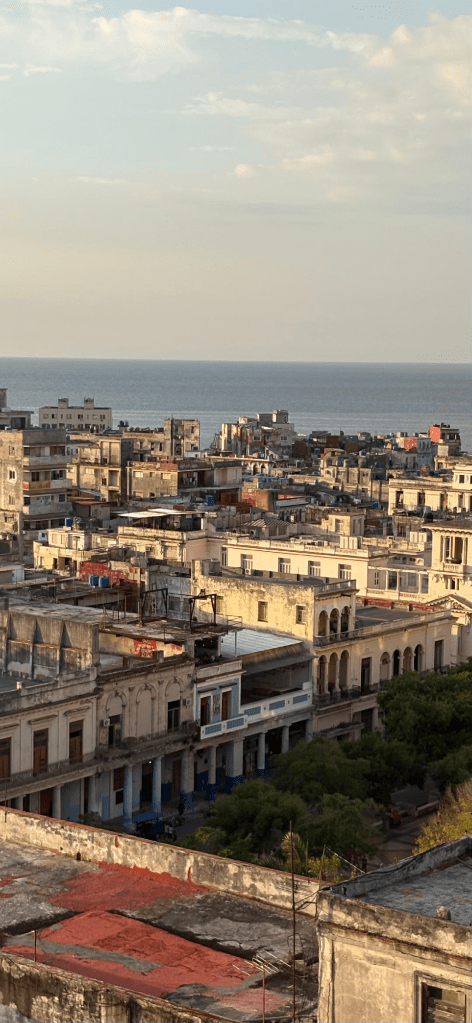
In many ways we experienced a tourist bubble. The hotel, Marques de la Torre, was comfortable and had a swimming pool on the roof with amazing views of Havana. The breakfast buffet in the hotel was abundant, though the food wasn’t that great for spoiled Americans. The only thing we had to contend with was sketchy WiFi. What was interesting is to find out that virtually everyone in Cuba has a cellphone. I took a photo of a room in the historic Nacional Hotel where the staff was taking a break and everyone was on a cellphone. You should know that the average monthly salary is $30-40. It is hard to believe that people can get by on that amount of money but housing, education costs, and some medical care is covered. People have to buy their own food. We all brought cash with us because there is no use of credit cards. We left a few dollars every day for our hotel maid. In Cuba, a dollar still means something as 500 Cuban pesos equal one dollar. We also brought monetary donations for the two synagogues we visited as well as an assortment of over- the- counter medicines, school supplies, household items and a variety of other goods.
We learned that the history of the Jews in Cuba goes back to Christopher Columbus. Sephardic Jews from Spain fleeing the Inquisition came over with him on his boats. At one point in the 1950’s before the revolution, there were maybe twenty- five thousand Jews divided between the Sephardic and Ashkenazi communities with five or six synagogues. Now there are maybe one thousand. We went to the Ashkenazi synagogue for Friday night services. They are a small group but they try hard holding Shabbat services, celebrating holidays and have a Sunday school. A young man, the son of the community president, told us all about what they are doing. He was charming and impressive and helped lead services. Suddenly towards the end of services all the lights went out. This is commonplace as there are rolling blackouts. We all headed to the bus to go to our Shabbat dinner in a hotel but somehow in the dark Jeff followed the local Cubans down stairs to their Shabbat dinner. When I realized he was not on the bus, our tour leaders went looking for him. I was glad to find him.
We also visited the Sephardic community and had the local leader speak to us in Spanish about his community with Vicky translating. The Sephardic synagogue is mostly just a senior center now and is not active. They had a small but haunting Holocaust memorial room. We visited the Jewish cemetery which sadly is rather overgrown with weeds. It would not take too much to get it looking better.
We learned about Cuban history and found out about the beloved national hero, Jose Marti, who was also a marvelous poet and philosopher. His image is all over Havana. We were enriched from hearing from several scholars. I especially enjoyed the lecture in art history at the Museum of Fine Arts. We saw some very unique art like mounted cockroaches and oversize hippos by the artist Roberto Fabelo and amazing paintings in different styles. We visited the Muraleando Community Art Project bursting with murals, sculptures and mosaics all made from piles of discards and garbage, several floors of the most creative artwork. We were entertained by a dance production put on by a young troop of dancers and heard a fascinating talk about Cuban music which is such an important part of the cultural scene. It was surprising to learn about the strong presence of Santeria, a combination of African and Cuban influences which blends Catholicism with the worship of spirits.
I especially enjoyed a lecture from a sociologist, Marta Nunez Sarmieto who explained about the place of women in Cuban society. Women are strongly represented in high positions outnumbering men as lawyers, doctors and in all professions. The interesting twist is that besides working full time, they also have second jobs to manage their households. It is not considered “macho” for men to help at all in the house, apparently a cultural norm. Divorce is also quite common and easily obtained.
We had a telling experience after having lunch at a lovely outdoor café. I had half of my bagel and lox left on my plate ( yes, bagel and lox in Cuba.) Four little boys approached me, pointed at my leftover sandwich to see if they could take it, and of course I said “yes.” They swooped it off my plate in seconds. What was sweet is how the “leader” divided it into small bites for everyone. The restaurant food in the private family-run restaurants we visited, known as paladars, was really very good. We were always welcomed with mojitos. I enjoyed the variety of fish, especially snapper, and rice and beans was a constant. Desserts like flan were yummy. Of course, this kind of fare was not available for the average Cuban, only for us privileged tourists.
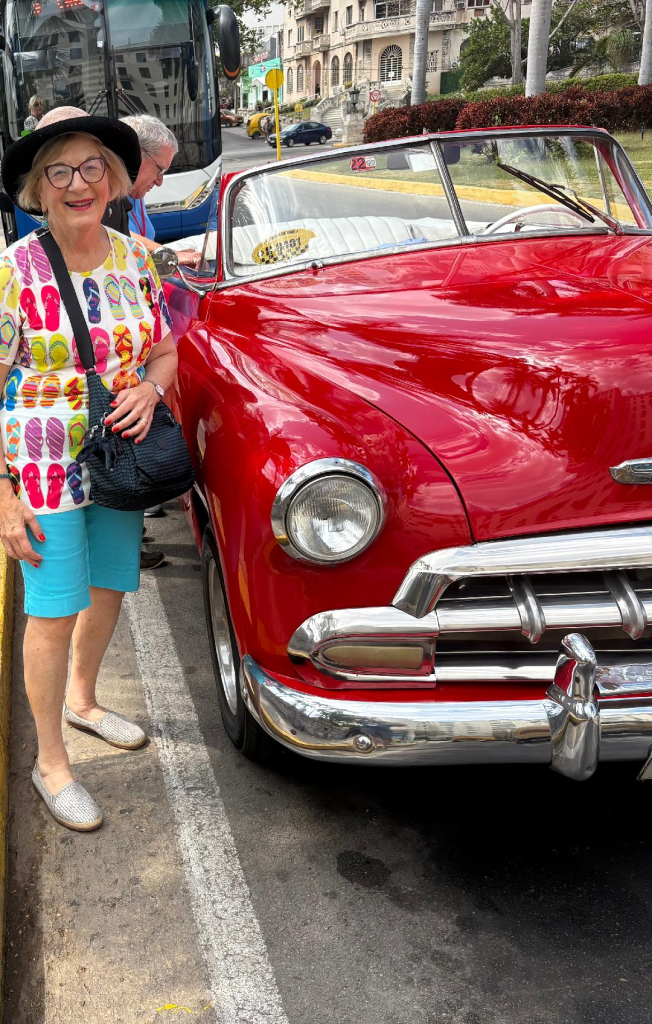
The infrastructure is really in bad shape. I saw many old grand edifices that were now crumbling buildings. I kept thinking that the buildings were like sad dowagers, who had their heyday and were once elegant. The mafia ran fancy casinos and nightclubs years ago now mostly gone. It was a treat to see the shiny old cars from the fifties and sixties everywhere, Chevy’s, Fords, Cadillacs, Studebakers. Jeff loved them. Their strong colors like hot pink, deep red, dark green and royal blue stood out. The cars look pristine and beautiful on the outside, but just don’t look under the hood. The engines are put together with whatever scraps they can find to get them running.
The Cuban people we encountered serving us in the restaurants were friendly and attentive. They really appreciated that we were there. Despite their difficulties, it was fun observing young women on the street dressed fashionably, coloring their hair and having long decorated nails. It is not as though they want any less than any fashionable women anywhere desire. It was amusing to learn that Cuban people love old westerns, religiously follow Spanish soap operas and American television. The six days I was there, I never saw any police which seemed surprising to me. I felt safe though there were many persistent beggars who approached us for dollars and self- peddled taxi drivers who wanted to give us rides constantly .
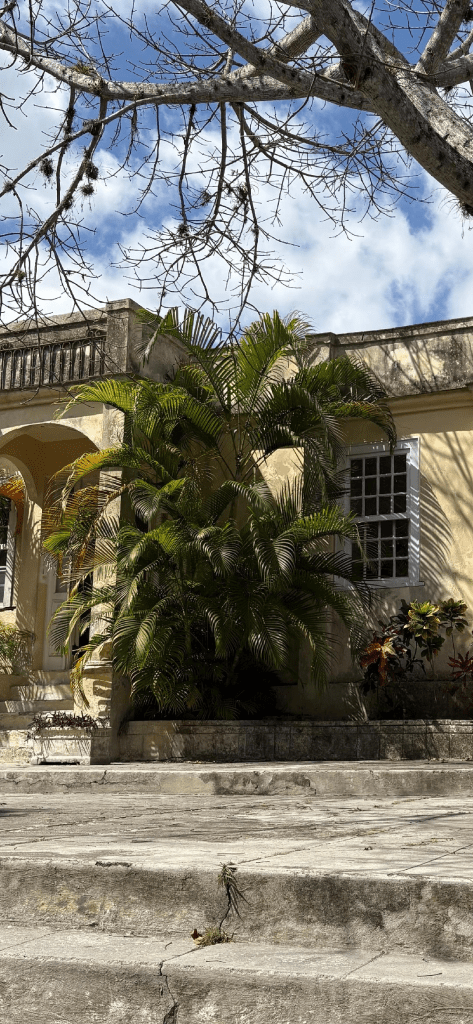
One of our interesting side trips was visiting the estate of Ernest Hemingway. It was a surprisingly cool day with elaborate clouds stretched across the sky. There were beautiful views from the terraces around the house. We wandered around but could not go in the main house, just peek in the rooms from the outside. The windows were open so we could see his library, his his bedroom, trophy animal heads on the walls, one of his typewriters, his Nobel Prize in a display case. I imagined him walking around the lush grounds probably having a cocktail. His boat was on display which he used to fish for marlin. It’s hard to believe all we saw and experienced in just six days. Havana was once a grand city and still is a place of beauty but overshadowed by struggles and shortages. The Jewish community is just hanging on but with its determination hopefully will keep on going.
 Joanne Jagoda