I just returned from a ten-day tour to Japan organized by Tiyul, a Jewish travel company out of Berkeley, expertly organized by Ariel Goldstein who leads tours all over the world. Thankfully, after more than a week of serious jet lag, I’m finally almost sleeping through the night and getting past the daily mid-morning crash. I’m beginning to think that traveling west brings on more jet lag than some other places we have traveled. What differs about Tiyul tours is that the itinerary seeks out Jewish highlights, which were limited in Japan as there are frankly not many Jewish people. We had fun traveling with several old friends, and we and met new friends from California and other states. These are some of my impressions after this wonderful tour.
It was not an easy country to navigate. Not many people spoke English and though we had our google translators, it was difficult to locate restaurants and read menus. We were on a tour so thankfully we could take the bullet trains by following our leaders with their yellow flag. The trains are amazing. If they say they are leaving at 11:09 am that is the time they leave, not a minute earlier or later. You better be in your seat in the right car. We really enjoyed our two Japanese tour guides. They answered our questions and educated us continually on Japanese history and customs. We learned the important dates of the “Shogunate”, the Japanese military rule, that ruled Japan from 1185 to 1868. Though the Emperor remained the official head of state, the actual power resided with the Shogun. In 1868, the Emperor took back power initiating Japan’s modernization.
Our tour leaders got us to where we were supposed to go. Without them, Jeff and I would have been lost (forever.) Arriving at the busy stations was an experience, with crowds rushing in all directions. It was a miracle no one in our group got lost. We traveled by bus and bullet train covering some of the major cities, Kyoto, Kobe, Nagoya and Tokyo.
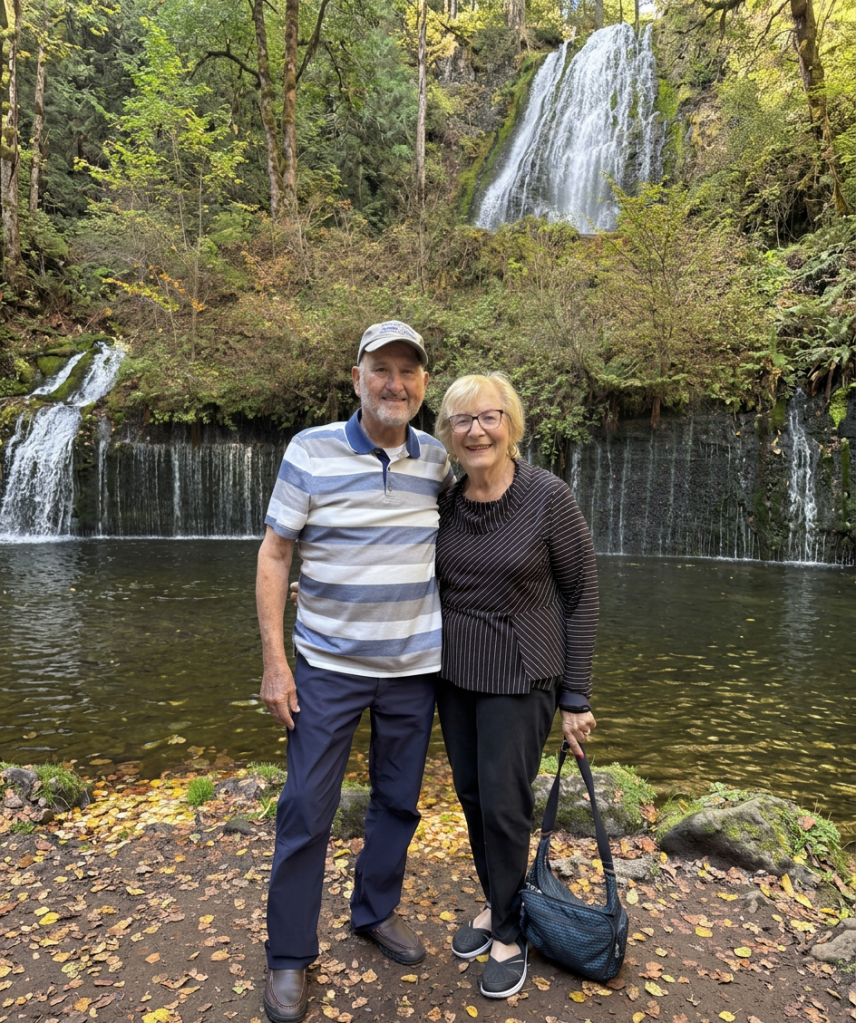
In terms of traditional Japanese experiences, we visited Shinto and Buddhist temples and shrines. We visited the Shogun’s castle in Kyoto, and the Golden Pavilion, an iconic site. We went to the Nishiki Market which reminded us of the shuk in Jerusalem, colorful stalls with vendors selling their wares. We also experienced a tea ceremony with kimono-clad women pouring tea for our group. I wish we would have had more tea ceremonies and the experience of learning how to wear kimonos but our days were filled from early morning. Some days we walked miles saw beautiful spots in natural settings including waterfalls and magnificent trees, some of which were beginning to turn to fall colors.
We also were fortunate to have two scholars who were with us, Fred Rosenbaum a historian and his wife Dorothy Shipps also a scholar with a degree in Asian studies. Fred kept us oriented with Japanese history before, during and after WWII. I did not realize the important influence of Douglas Macarthur on post WWII Japan. Dorothy also took us to a special presentation at St. Luke’s hospital founded by Dr. Rudolf B. Teusler in Tokyo where her great- aunt, Helen Shipps had worked as a Director of Medical Social Work which was a very high position for a woman in the 1930’s. Dorothy had been bequeathed a treasure trove of her aunt’s correspondence which chronicled a most tumultuous time in Japan. She is currently completing a biography of her great- aunt.
It was very powerful to visit Hiroshima. Dorothy Shipps introduced us to a friend of hers, Dr. Akemi Yonemura, a former UNESCO educator who grew up in Hiroshima, and we heard her story and perspective. It was difficult to absorb the horror of the photos we saw in the museum, and it was impossible not to be shocked at the total devastation. Over 100,000 people died and they never knew what hit them. Drawings of the victims seeking water with their skin literally disintegrating have made a lasting imprint in my consciousness. We also got to listen to recorded first- hand accounts of family members who survived the devastation.The Hiroshima Peace Park is dedicated to the lives lost and we saw paper cranes, a traditional design in origami, which visitors make in memory of Sadako Sasaki a young atomic bomb survivor who folded cranes while battling leukemia until she died. There is also a famous statue dedicated in her memory.
We visited a lovely town that we accessed by train, Karuizawa, which was known as a resort for Japanese and foreigners. We took a several-mile hike there to see some especially scenic spots. One day we saw the Ama divers, a traditional occupation for women who free dive to get abalone and pearls. We then went to the Mikimoto Pearl museum and the Toba Sea-folk Museum.
We also visited the Orizuru Tower, a beautiful rooftop pavilion we accessed by a tall elevator, highlighting the entire city of Hiroshima. We found Tokyo to be really overwhelming- modern, bustling, but still orderly crowds on the street crisscrossing packed intersections. There were enough high-end stores that it looked like Rodeo Drive. We were sobered by our visit to the earthquake museum in Kobe and saw a film showing the city being devastated by the enormous earthquake of 1995. One day we got a little jittery when we had an earthquake alert on our phone but it turned out to be far away. There have been several totally devastating earthquakes in Japanese history.
Of special Jewish interest, we learned the story of Chiune Sugihara, at a museum in his home town, Yaotsu. Fred Rosenbaum detailed Sugihara’s fascinating story as we drove on the bus. Sugihara was a brave Japanese diplomat in Kovno in Lithuania, who saved thousands of Jews who would have perished in the Holocaust had he not issued them exit visas. They got the visas then had to take a grueling train trip which led them to Japan, then on to Shanghai or other places where they found refuge. We went to a museum which told his story. The Sugihara visa was a valuable lifesaving signature. On a wall of this museum, I saw the photograph of a couple I recognized, the Milrod’s who went to my synagogue in San Francisco.
We also learned about another Japanese man who greatly helped the Jews, Abraham Setsuzo Kotsuji, who was instrumental in extending the visas that Sugihara had granted. In fact,he was responsible for saving the entire Mir Yeshiva, 300 students. What is interesting about Kotsuji is that he studied Hebrew and Hebrew texts even in Berkeley and became a Hebrew and biblical scholar leading him to eventually convert to Judaism, including being circumsized as an adult. He is buried in Jerusalem.
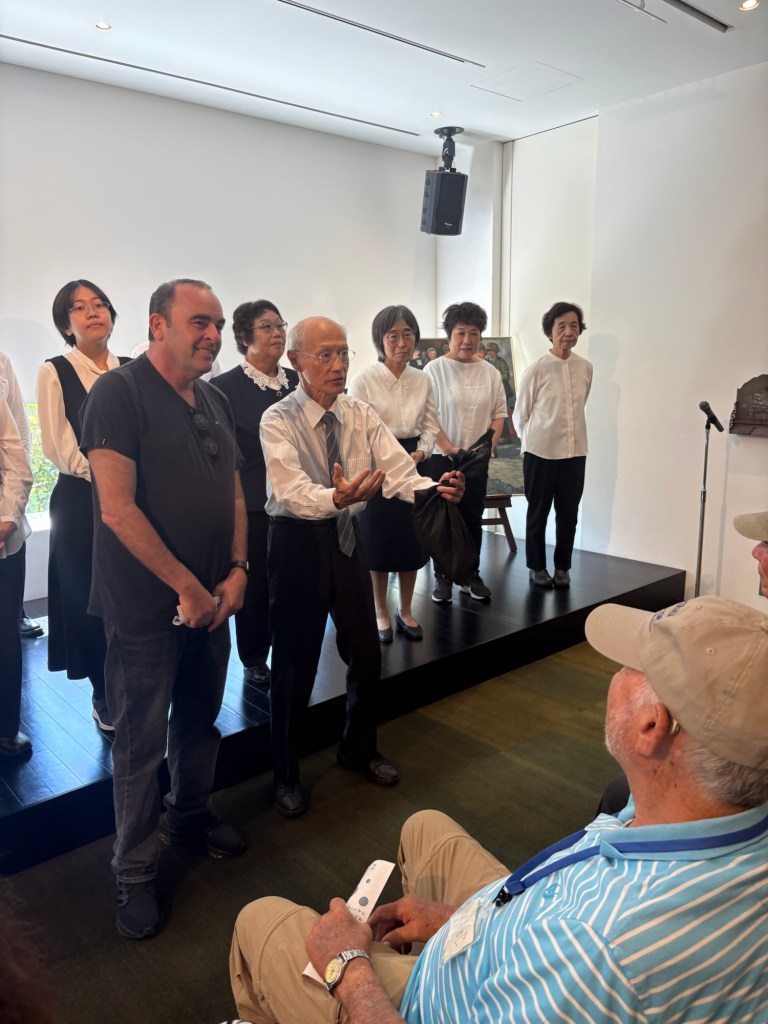
Another fascinating site of Jewish interest was the Holocaust Museum in Fukyama City in Hiroshima. The director of the museum, a reverend, spoke fluent Hebrew, and was totally dedicated to telling the story of the Holocaust. We were greeted by a lovely chorus singing Havenu Sholom Aleichem, which is a traditional welcome song in Hebrew. They sang several other songs to us after we toured the museum. It is noteworthy that thousands of Japanese school children tour the museum every year. There is a special room dedicated to Anne Frank with even a model of the room where her family hid, with quotes from Anne and her father. It was very touching and we learned that the Japanese are very familiar with the Diary of Anne Frank.
There are very few Jewish people who live in Japan though there are many tourists who come to the synagogue in Tokyo or Chabad centers for Sabbath meals. We enjoyed sabbath dinners on two Friday nights, once with Chabad, one at the Jewish Center of Tokyo, meeting their young vibrant rabbi. Interestingly enough there was no security at either location which is not what you find today in most synagogues in the United States or around the world.
Most of the time we stayed in modern hotels, some really fancy with every amenity, some less fancy. One night we experienced a Ryokan, a typical Japanese Inn. When we got to our room, we realized we would be sleeping on the floor on a tatami mat. There were no chairs in the room. I knew right away that my touchy back would not make it through the night so I requested another mattress which they readily supplied which was about four inches thick. It was added to the tatami mattresses, and it did the trick. It was still a fete to get up and off the mattress, definitely an experience. It took some agility and maneuvering, turning on my knees and holding on the wall. Jeff wrenched his knee from his acrobatics getting up off the bed!
An overall powerful impression is that this country is remarkably neat. There is not trash around anywhere, and I looked everywhere, even in empty lots or public spaces on the street. What is also remarkable is that there are not visible garbage cans. I had heard that people keep their own trash with them and bring it home. We actually kept small plastic bags with us for this purpose. Not only is it neat on the streets, but the people drive neat, not a lot of honking. I didn’t see any car accidents and hardly saw police. The Japanese park neat too, there is just a sense of order. Since I have been home, I found out Japanese school children maintain their own classrooms in their schools, no janitors. Apparently cleaning is part of the children’s daily schedule and they learn to take responsibility this way. Wow, a major cultural difference.
Something else that is ubiquitous are the TOTO toilets. If you have ever had the opportunity to sit on a TOTO toilet, be prepared for quite the experience; a warm seat, rushing water to clean front and tushies, even a noise disguiser so you can do your business in private. And these toilets were everywhere, even in public bathrooms. I guess this says something about the culture with the cleanest tushies in the world. I was fascinated by the TOTO’s. In fact on all the toilets we visited in our travels, I only saw one toilet that was not pristine.
We also said, oh thank heaven for 7 11 as we relied on these ubiquitous little stores which were everywhere. They made the best deviled egg and tuna sandwiches which were a welcome familiar meal when we were lost or looking for something small. We were delighted to find we could make our own smoothie’s with a smoothie machine, There were many impressive shopping centers and flashy stores. There was nothing you could not buy if you know where to look and how to ask.
The women are lovely with very white skin. Apparently they shelter from the sun and it makes a huge difference . I did not see any overweight men or women. The overall color palate was black and white with a sprinkling of beige. I had asked AI about what to wear in Japan and AI advised me to select neutral colors. Men frequently wore black suits with white shirts. Some of the women wore longish skirts; always stylish and conservative. There was no overall flaunting of decollete, no boobs showing with lowcut tops.
One of the fun things I observed was a dating scene in our hotel. Couples met up in a large hotel room over drinks. The men were mostly in black and white, black suits and white shirts. The women were dressed attractively and conservative. It reminded me of being in Jerusalem on Thursday nights when there are dating scenes in some in the religious community.. My husband and I love to park ourselves unobtrusively so we can watch the couples and guess who might be a click or not. It was surprising to learn from our tour guide Hiro that the birthrate is very low and 80% of young people in their twenties don’t want to get married citing the high cost of living as a reason.
Our favorite meal was vegetable tempura we had in a restaurant helped in ordering by the friendly English- speaking young woman on the table next to us who knew we needed help. We also were helped by the concierge at one of the hotels who we followed to find the elaborate food market at the ground floor of the hotel we were staying in, which required some skillful navigating. Several of the hotels had shopping malls connected to them. We enjoyed our visit to Japan overall and admired the neatness of the country and people and loved the toto toilets and 7’11’s.


the opportunity to learn from Fred Rosenbaum, in Japan. wow! He taught at Temple Isaiah over 50 years ago, when he was at Cal.
LikeLike
that’s really a coincidence. he was my TA at Berkeley too.
LikeLike